- Get link
- X
- Other Apps

A fully funded Masters degree in the United Kingdom is open for applications, and Pakistan is on the eligible list. Commonwealth Shared Scholarships 2027 pay full approved tuition plus a monthly stipend of £1,712, with applications closing at 16:00 GMT on Tuesday 8 December 2026. The scheme is a United Kingdom government programme funded by the Foreign, Commonwealth and Development Office and jointly funded with participating United Kingdom universities. It supports full time one year taught Masters study only, with study starting in September or October 2027. Applications opened on 10 November 2026, so the window is short and the deadline is firm.
This guide covers what the scholarship pays, who can apply, which artificial intelligence and computer science courses fit, and how to apply. Around 180 awards are expected for 2027/28, and Pakistan is confirmed eligible among 43 eligible countries. Every figure below comes from the official Commonwealth Scholarship Commission, checked on 25 November 2026.

Commonwealth Scholarship Commission logo. Image: Commonwealth Scholarship Commission in the UK.
What the scholarship pays for
The funding is designed for students who could not otherwise afford study in the United Kingdom. The scholarship covers approved tuition fees in full, so scholars are not liable for any part of the tuition fee. The Commission notes on its university bids page that it pays course tuition fees up to a cap of £22,500, while the candidate page promises full approved fees, so the honest position is full tuition covered for an approved course. Approved airfare is also covered.
The monthly stipend is paid and funded by the university at current rates. The stipend is £1,712 per month, or £2,000 per month for universities in the London metropolitan area. Durham University notes that 2027/28 rates are to be confirmed, so treat these figures as current published rates, not a final promise.
| Funding item | What it covers |
|---|---|
| Tuition fees | Approved fees in full, no part payable by the scholar |
| Monthly stipend | £1,712 per month, or £2,000 per month in London |
| Airfare | Approved travel to the UK and return |
| Thesis grant | Thesis costs where applicable |
| Study travel grant | Travel linked to study |
| Tuberculosis test | Contribution where a visa requires the test |
| Child allowance | £622 first child, £154 second and third child under 16, eligible single parents only |
Extra support is available in defined cases. A child allowance is paid only if the scholar is widowed, divorced or a single parent, and only if the children live with the scholar at the same United Kingdom address. A disability support assessment is also offered.
Who can apply
Eligibility is strict, and the Commission checks each rule. You must be a citizen of, or have been granted refugee status by, an eligible Commonwealth country and be permanently resident there. Pakistan meets that test. The full eligible list is Bangladesh, Belize, Botswana, Dominica, Eswatini, Fiji, Gabon, Ghana, Grenada, Guyana, India, Jamaica, Kenya, Kiribati, Lesotho, Malawi, Malaysia, Maldives, Mauritius, Montserrat, Mozambique, Namibia, Nauru, Nigeria, Pakistan, Papua New Guinea, Rwanda, Saint Helena, Saint Lucia, Saint Vincent and the Grenadines, Samoa, Sierra Leone, Solomon Islands, South Africa, Sri Lanka, Tanzania, The Gambia, Togo, Tonga, Tuvalu, Uganda, Vanuatu and Zambia. You must be available to start study in the United Kingdom by September 2027.
The degree rule catches many applicants. By September 2027 you must hold a first degree of at least upper second class (2:1) honours standard, or a lower second class degree plus a relevant postgraduate qualification, usually a Master degree. Work experience cannot replace the degree requirement. You must also be unable to afford study in the United Kingdom without this scholarship. There is no age limit. You must not have studied or worked for one academic year or more in a high income country, although distance learning while resident at home is permitted and must be declared.
The Commission does not require an IELTS test, but universities may require evidence of English proficiency. Selection is based on candidate merit, the quality of the research proposal, and the potential impact on the development of the home country.
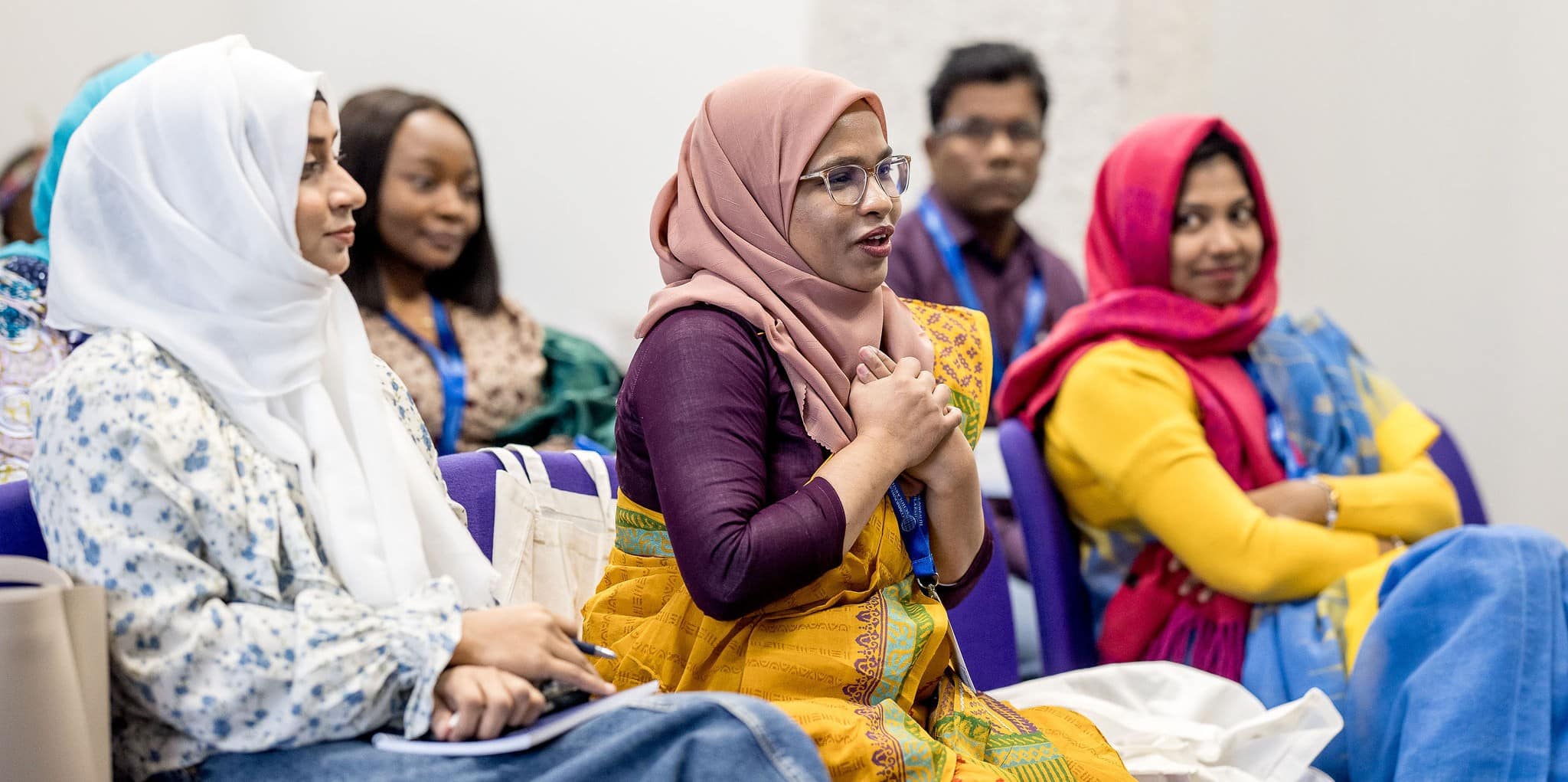
Commonwealth Scholars at an official event. Image: Commonwealth Scholarship Commission in the UK.
The six development themes your course must fit
Every approved course fits one of six development themes set by the Commission. Your chosen course must fit one of the six CSC development themes, or your application will not count. The themes are broad, and artificial intelligence and computer science courses fit naturally into several of them, especially science and technology for development and promoting innovation and entrepreneurship. Check the theme listed for your course on the official eligible courses list before you apply.
- Access inclusion and opportunity
- Improving population health, health systems and capacity
- Promoting innovation and entrepreneurship
- Science and technology for development
- Strengthening peace, security and governance
- Strengthening resilience and response to crises
Artificial intelligence and computer science courses to target
The official eligible courses list includes strong options for artificial intelligence, data science, cyber security and related fields. Artificial intelligence and computer science applicants have real choices on the official list, including dedicated artificial intelligence Masters degrees at several universities. Search the full list for the course that best matches your background, and check each university page for entry requirements and its own admission deadline.
| Course | University |
|---|---|
| MSc Artificial Intelligence | Brunel University of London |
| MSc Artificial Intelligence | University of St Andrews |
| MSc Data Science and Artificial Intelligence | Sheffield Hallam University |
| MSc Data Science and Artificial Intelligence for Sustainability | Cranfield University |
| MSc AI and Digital Chemistry | University of Nottingham |
| MSc Artificial Intelligence for Medicine and Healthcare | University of Bristol |
| MSc Health Data Science and AI | University of Stirling |
| MSc Data Science | University of Surrey |
| MSc Cyber Security | Bournemouth University, University of Hertfordshire and University of Wolverhampton |
| MSc Security and Data Science | University of Exeter |
| LLM Artificial Intelligence, Law and Technology | Brunel University of London |
| MSc Business Intelligence and Digital Marketing | Brunel University London |
| MSc FinTech and Policy | University of Surrey |
How to apply step by step
There are two applications to manage, not one. You must apply for university admission and apply for the scholarship separately, and both routes have their own deadlines.
Step 1: Pick an approved course
Check the official eligible courses list and pick an approved course that fits one of the six development themes. Only an approved course counts, so confirm your course is on the official list before you do anything else.
Step 2: Apply for university admission
Apply for admission through the university own admissions process. University deadlines differ, so check the deadline for your chosen university and do not assume it matches the scholarship deadline. Durham and Queen's require the university admission application by 16:00 GMT on 8 December 2026. Imperial sets its course application deadline at 23:59 GMT on 6 January 2027. Strathclyde says do NOT submit a course application until after nomination.
Step 3: Apply for the scholarship through CSC Central
Apply for the scholarship through CSC Central, the Commission online application system, linked from the Commission Shared Scholarships page. Start from the Commission page and follow its link to CSC Central, rather than typing the portal root address. The form asks for three referees, one a current employer if applicable, up to 10 publications and prizes, employment history, award objectives, career plans for the 5 years after the scholarship and long term plans, a detailed plan of study, a personal statement, and a voluntary activity and leadership summary.
Step 4: Upload supporting documents
Upload supporting documents by the same deadline. References and supporting documents are also due by 16:00 GMT on 8 December 2026, so chase your referees early. You need a valid passport or national ID showing photo, date of birth and country of citizenship, full transcripts for ALL higher education qualifications with certified translations if not in English, and references from at least two individuals in PDF, signed and on institutional letterhead.
Step 5: Submit before the deadline
Submit your scholarship application by 16:00 GMT on Tuesday 8 December 2026, which is 21:00 PKT. Submit before the deadline, not at the deadline, because the system will be busy and a late submission will not count.
Deadlines and timeline
The timeline is tight, with a long wait after submission. Applications opened on 10 November 2026 and close at 16:00 GMT on Tuesday 8 December 2026, with references and supporting documents due by the same time. Universities nominate their chosen candidates to the Commission in March 2027. The outcome is expected around mid June 2027, according to Durham University. Study then starts in September or October 2027.
| Stage | Date |
|---|---|
| Applications open | 10 November 2026 |
| Scholarship deadline | 16:00 GMT on Tuesday 8 December 2026 |
| University admission examples | Durham and Queen's by 8 December, Imperial by 6 January 2027 |
| University nominations | March 2027 |
| Outcome | Around mid June 2027, per Durham University |
| Study starts | September or October 2027 |
The Pakistan caveat you must read
Pakistan is eligible, but two honest caveats affect applicants from Pakistan. The Commission bids page asks that no more than 50 percent of nominations per university come from Ghana, India, Nigeria and Pakistan combined. That is a cap on the combined share from those four countries, not a ban on Pakistan, and it means competition among applicants from those countries is intense.
One university adds its own note. Bournemouth University says for its MSc Public Health only it would prefer not to recruit Commonwealth Scholarship Commission applicants from Ghana, India, Nigeria or Pakistan due to application volumes, with no country restriction on its other programmes. That note applies only to that one Bournemouth course, not to other Bournemouth programmes or other universities. Read the course note for every course you shortlist.
Is this scholarship right for you
This scholarship suits a graduate who wants a one year taught Masters in the United Kingdom and cannot pay for it without help. It is a strong fit if you hold at least an upper second class degree, or a lower second class degree plus a relevant postgraduate qualification, and you can show a clear plan to use your study back home. It does not fund undergraduate study, PhD study or part time study. If you fit the rules, apply now, because the 8 December deadline leaves only days to gather transcripts and references.
Watch on YouTube: Celebrating 65 years of Commonwealth Scholarships
Video: This is the Commonwealth Scholarship Commission 65th anniversary video, not a Shared Scholarships specific video. Video: CSCintheUK, the official Commonwealth Scholarship Commission YouTube channel.
Verdict: Apply now if you are eligible, because a fully funded United Kingdom Masters with full tuition and a monthly stipend is rare, and the deadline is 8 December 2026.
Best for: Pakistani graduates with at least an upper second class degree who want a one year taught Masters in artificial intelligence, data science, health or cyber security and who can show development impact back home.
Watch out for: the 16:00 GMT deadline, the different university admission deadlines, and the combined nomination cap for Ghana, India, Nigeria and Pakistan.
Try it yourself: Open the official eligible courses list today and shortlist three approved courses that match your degree and your impact plan.
For each course, note the university, the theme and the university admission deadline. Then email your two referees today and ask them to prepare a signed reference on institutional letterhead in PDF. Start your CSC Central application with your personal statement and your 5 year career plan, and submit well before 16:00 GMT on 8 December 2026.
Quiz: Test what you learned
Question 1: What is the deadline for Commonwealth Shared Scholarships 2027 applications?
Answer: 16:00 GMT on Tuesday 8 December 2026, which is 21:00 PKT, with references and documents due by the same time.
Question 2: How much is the monthly stipend, and what is the London rate?
Answer: £1,712 per month, or £2,000 per month for universities in the London metropolitan area, at current rates.
Question 3: Can work experience replace the degree requirement?
Answer: No, applicants need at least an upper second class degree or a lower second class degree plus a relevant postgraduate qualification.
Keep reading on Learn Daily AI
Compare this with United States scholarships on the blog. Read the American University Emerging Global Leader Scholarship for a full ride option in the United States, and the Vanderbilt Ingram Scholars guide for full tuition with a 1 December deadline. For career planning after your degree, read How to get an AI job in the USA for a practical route into United States artificial intelligence jobs.
Your turn
Which course on your shortlist fits your impact plan best? Tell us your course choice in the comments, and share this guide with a graduate who should apply before 8 December.
Follow Learn Daily AI on Instagram at @learningdailyai for one new AI story every day.
Sources: CSC Shared Scholarships applications page, CSC eligible courses list, CSC university bids page, CSC 65 years page.
Comments
Post a Comment